Chord Lab
AI-assisted harmony learning and composition environment
Chord Lab is a Unity-based application that explores how generative AI can support music composition learning. It combines flexible AI-assisted harmonic planning, revision, and tutoring with deterministic systems for realization and critique. It was developed as the major research project for Toronto Metropolitan University’s Master of Digital Media program.
Compose Mode
Compose Mode allows for open-ended AI-assisted harmonic exploration. A learner can work from a melody, develop or request a harmonic plan, generate an SATB realization, inspect critique results, revise selected regions, and export their work as MIDI.
Lesson Mode
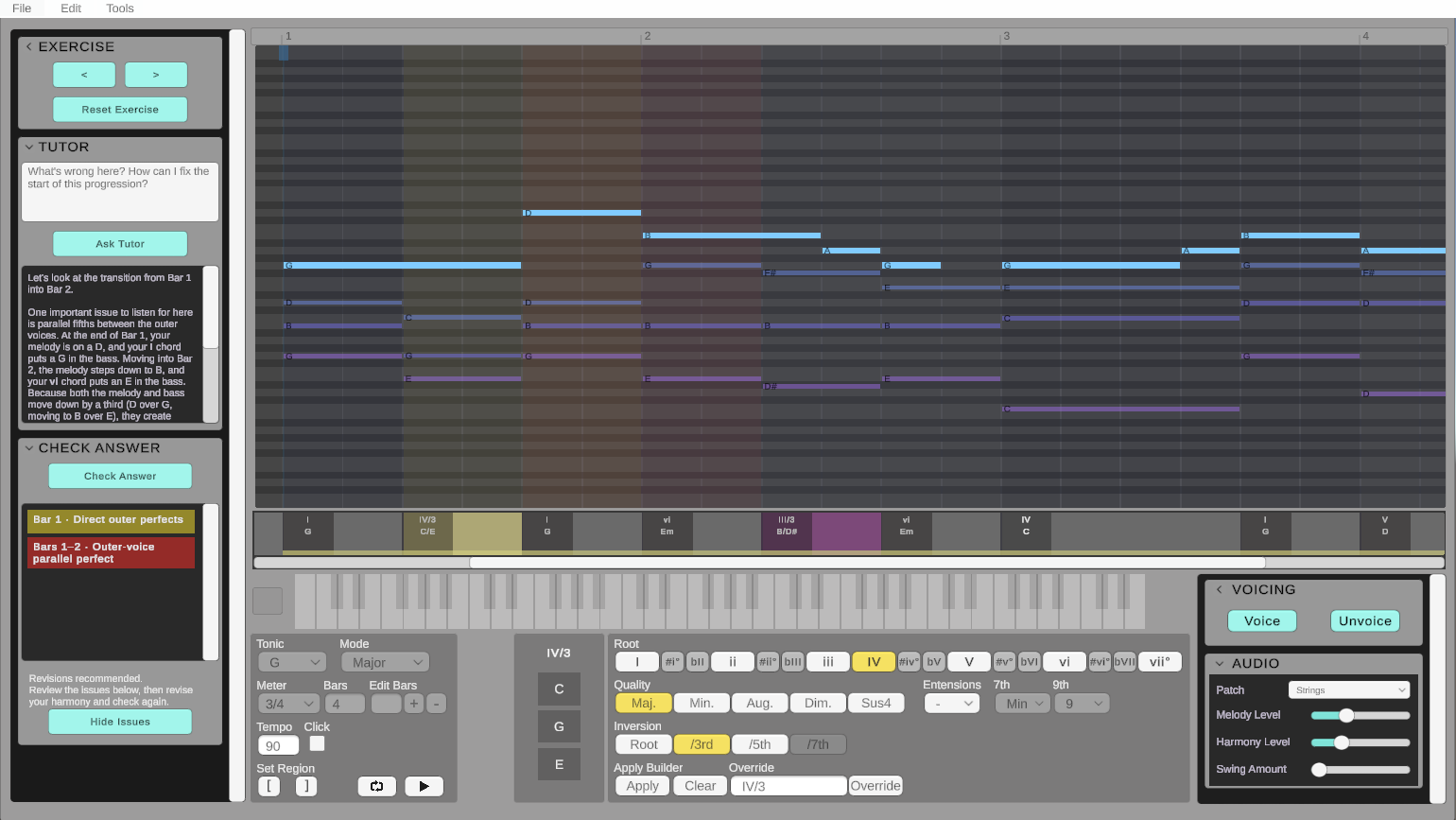
Lesson Mode adapts the same underlying systems to structured exercises. It combines exercise-specific constraints, deterministic answer checking, conversational guidance, and a broader musical review intended to discuss effectiveness and stylistic fit beyond categorical correctness.
Hybrid Architecture
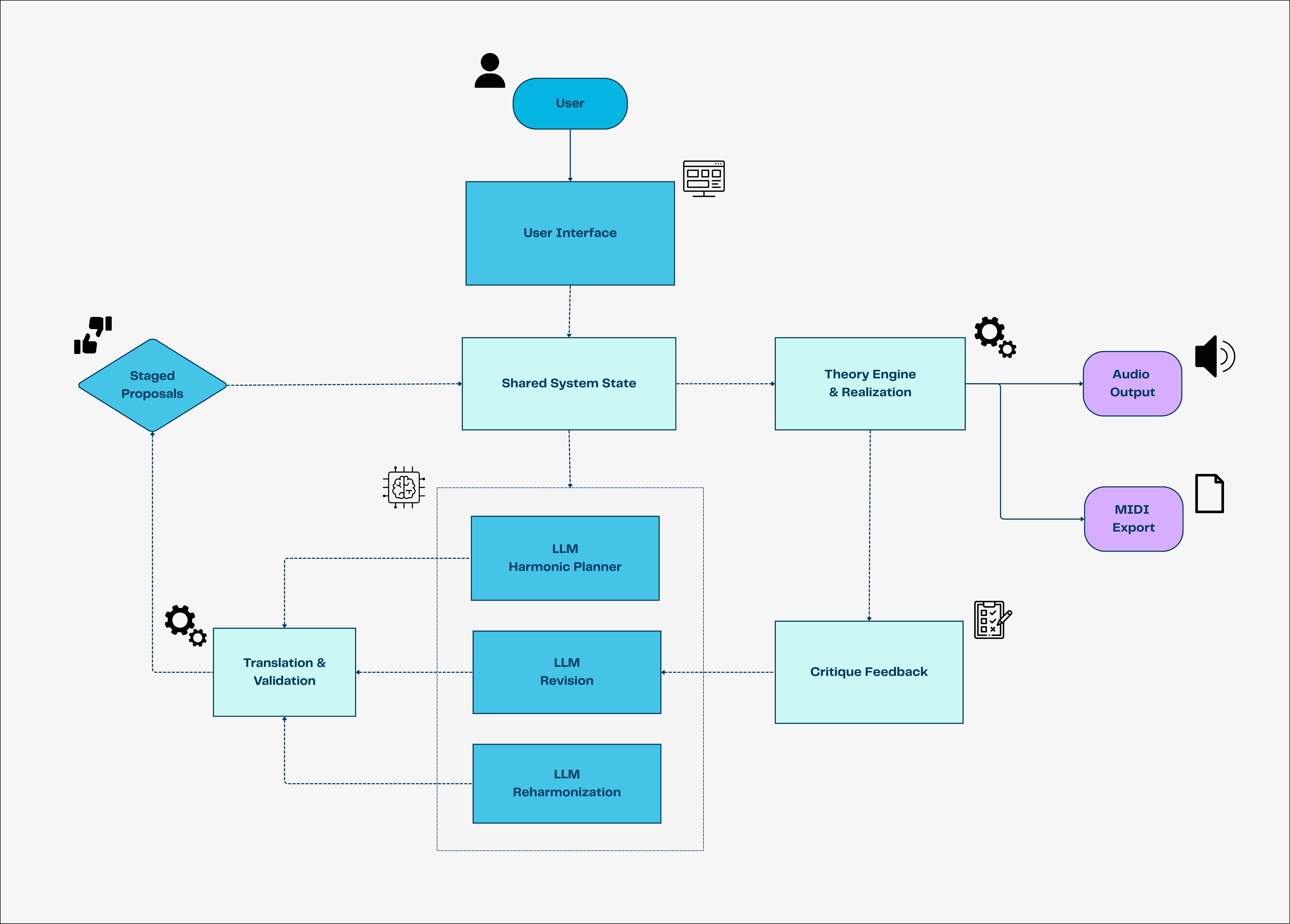
The prototype separates responsibilities among AI-assisted planning, symbolic validation, deterministic realization, critique, and revision. Flexible interpretation and explanation are handled by language-model components, while deterministic systems validate harmonic input, realize four-part textures, and identify rule-based issues.
Interface Evolution
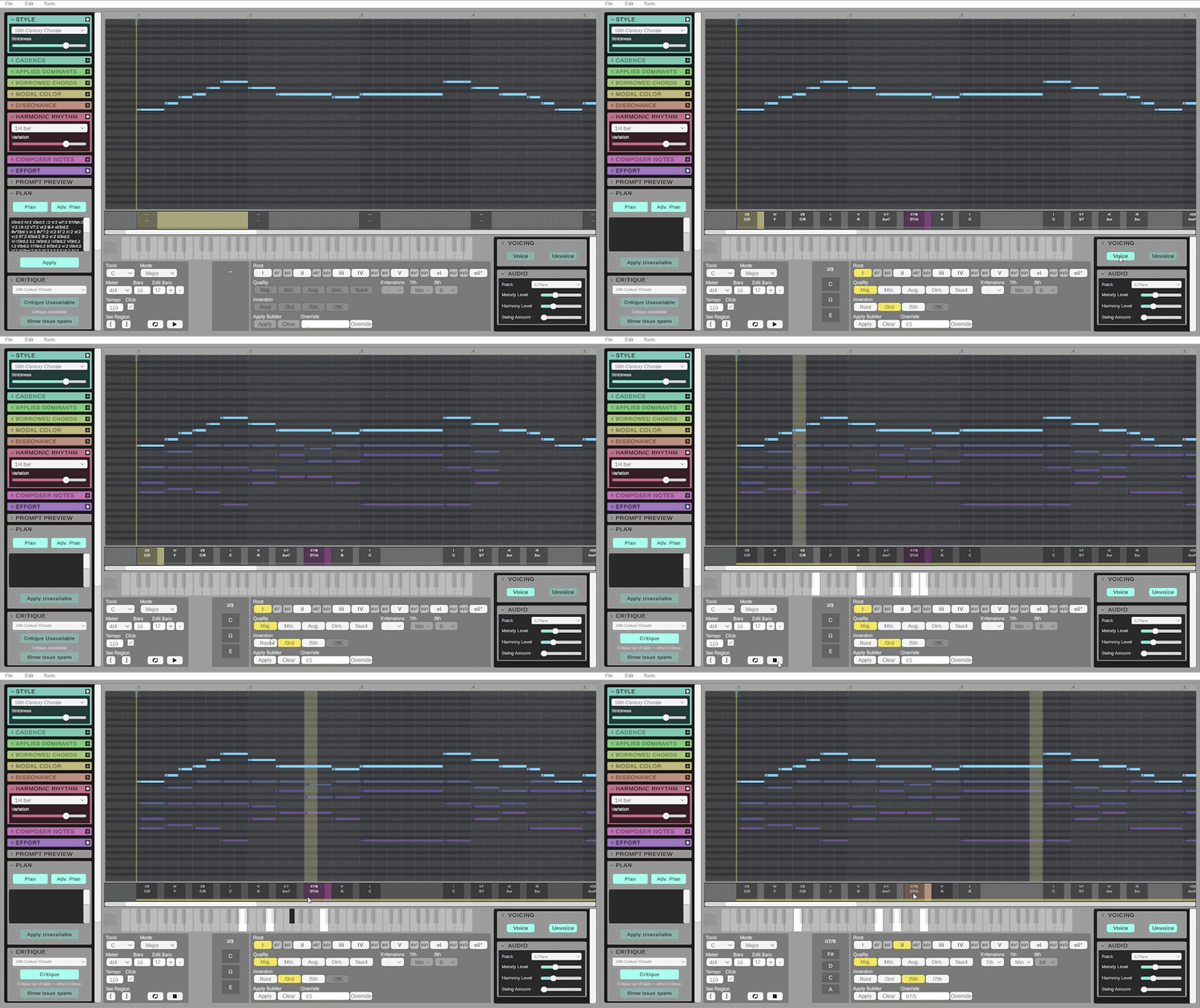
The development of Chord Lab involved an iterative design-thinking process, which moved through repeated cycles of understanding, defining, ideating, prototyping, and testing. The video below shows the user interface at various stages of development.
Research Evaluation
Chord Lab was evaluated through four case studies examining its deterministic realization engine, Harmonic Planner, Critique/Revision pipeline, and Lesson Mode. The deterministic engine produced generally reliable SATB realizations, while the Planner remained within the study’s two-error threshold in 17 of 18 runs. The Critique/Revision pipeline was able to identify and repair selected categorical errors, and Lesson Mode demonstrated how deterministic answer checking could be combined with contextual explanation and broader musical feedback.
The study did not include formal user testing. Future work will therefore involve learners and educators alongside continued refinement of the prototype. The complete thesis will be linked here once it becomes publicly available.